

I'm worried about my brain.
Some thoughts on brain rot, early parenthood and digital gardens

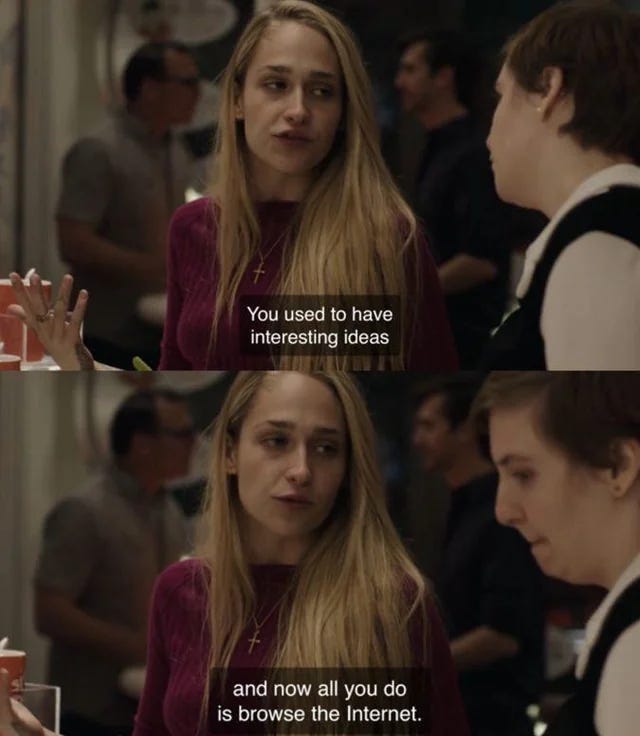
The scene: It’s 7pm and I’m sat next to my son’s cot, performing my nightly routine of ‘shhhing’ and patting his stomach with decreasing frequency and increasing levels of despair. He will not sleep. I’m perched on my husband’s office chair, with one arm slung over the side so that the cot’s wooden railing digs into my armpit. Occasionally my son will also tire of the patting charade and insist that I offer my hand so that he can grip it tightly. There is no escape. After approximately four minutes my other hand retrieves my phone from my back pocket. I start scrolling, searching for something –anything – that might distract me from quite how mind-numbingly dull this whole put-down process is.
I then “read” substack articles - and by read I mean flit through them so quickly that I cannot possibly have digested them with any degree of intelligibility. I check my emails more than once. I watch reels on instagram which implore me to launch a digital products business, or buy into some sort of multi-level marketing scheme, or tell me that the Nobel Laureate Olga Tokarczuk has started incorporating LLM into her book research (fml). My brain gorges itself on the shallowness of this content, reading everything, retaining nothing.
After almost an hour he falls asleep. I creep out of the room and try to recall that interesting article about—what was it now? Well, I can’t remember. I hate myself, briefly, before heading downstairs and gorming out on my phone some more.
Early parenthood provides the perfect conditions for brainrot
I think parents of young children are particularly vulnerable to the kind of doomscrolling which results in brain rot. This is largely because there are large chunks of our day where we must be physically but not necessarily mentally present. For instance: this morning my kids were playing happily by themselves, but I still needed to be in the room with them in case my one year old threw himself off the sofa1 a little bit too enthusiastically.
These gaps of time tend to not be long enough to do anything that is very cognitively demanding. In my experience caring for two children under the age of four makes it very difficult to: read books or newspapers; work; go to the toilet alone; write; take a shower; engage in my hobbies like knitting or quilting; or even cook a meal that involves the slightest level of complexity. These are all things I did quite happily until my first bundle of joy arrived. Now there are two of them I’m snookered. (Disclaimer: if you are that parent who does manage to *do stuff* whilst watching your kids, then good for you! I am not that person.)
Over the years I’ve tended to use these liminal periods of time to instead live out a somewhat vicarious existence. As I tidy up the kitchen I might listen to the Newsagents podcast or watch a new YouTube video from Andrea Mowry. Evenings spent sat next to my son now become a time where I read other peoples digested takes on the world. I might try and link back to the original source, but honestly, I’m usually too tired to do this kind of due diligence. I just want to zone out from what has usually been a pretty demanding couple of hours.
Mothers are on the frontlines of cognitive warfare
Today mothers of young children face a cognitive battle on two fronts. On the one hand, we know (thanks to a nascent field of research) that our brains alter during pregnancy. A study of 25 first time mothers led by Elseline Hoekzema noted that there were ‘substantial changes in brain structure’, and (somewhat terrifyingly imo) ‘reductions in grey matter volume’ in the areas of the brain that affect social cognition which last for at least 2 years post-pregnancy. The hippocampus, a part of the brain linked to memory, also loses volume!
In an interview with Science.org Hoekzema was quick to downplay the notion that pregnancy makes you stupid. Instead she pointed to the fact that women’s brains are rewired in ways that make them more effective in caring for their infant. Our ability to detect threats to our infant is heightened, for example, as is our sensitivity to infant distress. Our brain restructures itself in ways that serves the biological transition of becoming a parent.
The findings of the study are fascinating, and on some level, something to take comfort from. But it doesn’t diminish the flip side of this story - the fact that today any woman who gives birth does so against a backdrop of unprecedented technological and cultural upheaval. So whilst I hate to perpetuate any notion that becoming a mother results in ‘baby brain’ I do think we need to face up to the wider context in which this is all unfolding - a world in which our attention is constantly trying to be captured and manipulated by corporations for commercial gain.
Any new mother who regularly doomscrolls in the manner I described above will now find herself in a highly vulnerable situation. A 2021 study showed that doomscrolling or ‘PUI’ (Problematic Usage of the Internet) resulted in ‘replicable gray matter reductions in the dorsolateral prefrontal cortex’ - the area of our brain responsible for many executive functions. Mothers who spend large amounts of time using LLMs2 will also be vulnerable to the cognitive weakening that last year’s MIT study ominously warned us about. It found that ChatGPT users ‘consistently underperformed at neural, linguistic, and behavioural levels’ compared to ‘brain only’ participants.
Becoming human again?
In the past month a couple of things have happened which have led me to reflect on my brain and how well (or not) it seems to be functioning. This time a month ago my husband and I found ourselves in the utter depths of sleep deprivation as our youngest simply refused to sleep. A series of illnesses had completely screwed up the small amount of sleep training that we’d attempted, and we were now living with the consequences. I think it’s fair to say that this is one of the hardest periods I’ve ever experienced as a parent.
As a consequence I made the executive decision that our son would no longer sleep in our bedroom. That approach was getting us nowhere. I’m pleased to report that having been expelled he is now, very slowly, beginning to sleep independently. The first couple of nights that we only had to get up twice felt like a miracle. Last night he slept from 8pm through until 2.30am before stirring again at 5.30am. It might not sound like it but this is progress! I can feel myself becoming a human again.
And as I become a human being again I’m wondering how I can nurture and restore my brain. My poor brain. It has all these clippings and scraps of knowledge but there’s no real system that helps me retain and cultivate that information. Thanks to my doomscrolling tendencies everything gets composted down into one indeterminate blob of, well, nothing really. There are trends and soundbites but I struggle to develop arguments and avenues of thought in the way I once did.
I often think back to when I was at university and had a very systematised approach to note taking, which was reliant on printing out articles and writing out notes using pen and paper. There was something about that process that embedded other people’s arguments in my mind, but also enabled me to develop my own perspective - which I’d then translate into an essay. I’m finding myself wanting something akin to this to help strengthen my cognitive function.
Can Digital Gardening give me my brain back?
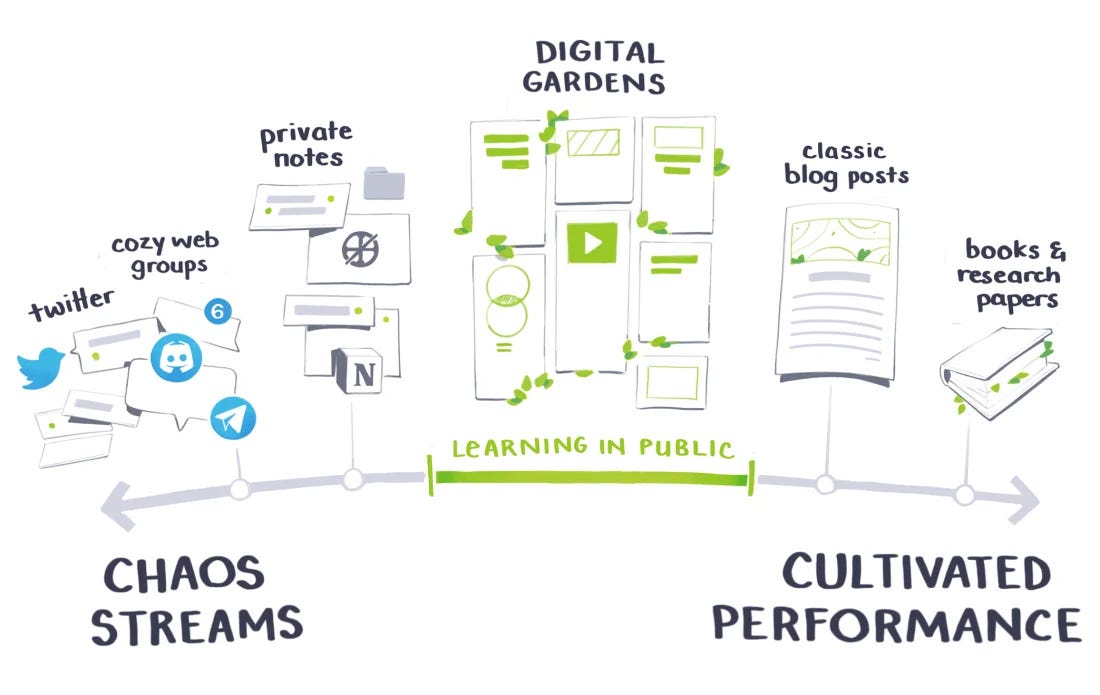
This question, of how I might support my brain as it recovers from pregnancy, has led me to the practice of Digital Gardening, a brief history of which you can read about here. In essence, a digital garden is a digital environment which functions as a sort of highly personalised wikipedia. There are numerous platforms which could host your garden - Notion and Obsidian seem the most popular. Unlike a blog or substack creating a Digital Garden isn’t primarily about sharing knowledge with others, but rather about having an online space in which you can cultivate and build connections across an infinite range of interests and sources.
In her viral Youtube explainer digital gardener Anna Howard says that:
a digital garden is a place that makes it possible to make connections between all of the things that you are consuming so you’re not just taking notes in a notebook or writing a blog where things are going to be all chronological. Instead you can write about a certain topic and you can connect it to all of the other things that have to do with that topic … and you can see the ways that all your interests are interconnected.
This approach appeals to me on a number of levels. Firstly, it encourages you to read and note-take with some level of intention. I’m already finding myself thinking ‘is this an article that feels worthy of adding to my garden?’. If not, then it’s probably not worth my time.
A fundamental aspect of digital gardening is that it’s not merely about making notes which quote a book or a podcast or film. A digital gardening approach to knowledge-building then demands that you step back from your original notes and write a new note that frames that knowledge source from your perspective. It asks: what do you think about the way this book engages with gender politics? What do you think about this statistic or news story?
But the primary attraction for me is that it creates a digital record of my consumption. My digital garden effectively creates a paper trail of where my mind has dwelt for the past week or so, something which is invaluable for the writing of Substacks (like this one) and longer-form pieces of writing. It takes what (for me) was time wasted and creates an invaluable library of highly tailored information.
I want to say to any mothers reading this: I have only been able to consider building a digital garden since my son started sleeping properly. If you are in the wilderness and what I’m saying feels like an impossibility right now, it probably is. Look after yourself as best you can. There is light at the end of the tunnel!
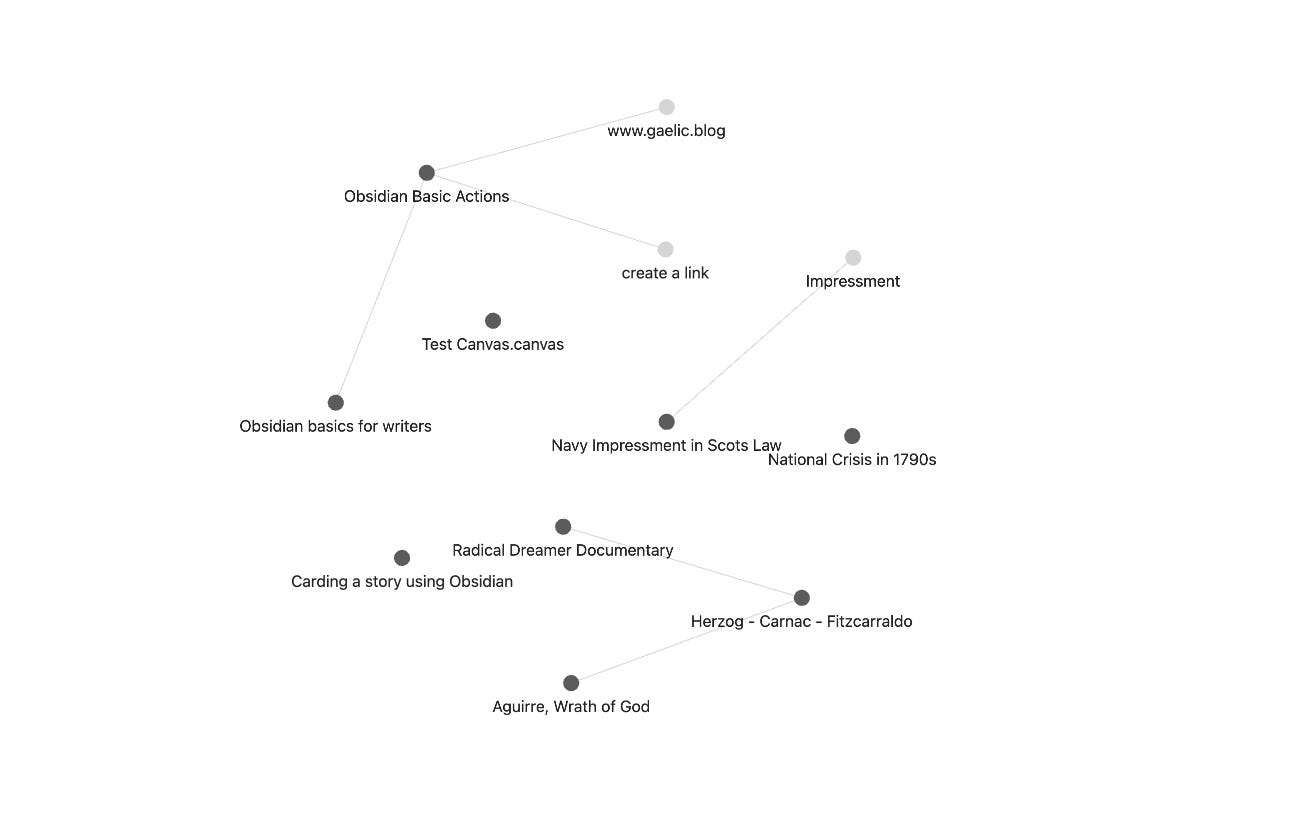
I am in the processes of setting up a digital garden on Obsidian. If you are interested, I’d highly recommend watching this how-to guide by Odysseas.
This week, I’ve made notes about money and relationships, the limitations of our existing climate stories, and Iris Murdoch’s novel The Italian Girl. The experience of writing notes in this way has been incredible, I have been amazed by the way in which I can feel my brain working and building connections in a way it has not been required to for several years. I highly recommend it.
I’ll keep you updated as I try to claw back my grey matter!
Resources:
Guide to setting up Obsidian via Odysseas
Creating a digital garden to end my doomscrolling via Anna Wharton
How to actually do research in the age of AI via Shae O.
If you enjoy The Murmuration and consider yourself a regular reader, then please consider becoming a paid subscriber. Writing these essays takes time! By chipping in a small amount each month you help make this work possible and available to others for free. (I do not paywall my content).
His favourite thing to do in the whole world
My hunch is that doomscrolling is the bigger issue for new mums
Oh my gosh yes! I've been pondering this for years. I used to call it digital escapism. The reality of the boredom, tiredness, mundanity and meeting needs led me to completely zone out as a brief respite of 'me time'. I absolutely feel the need to use my brain well again but the habits are 9 years deep at this point. I've often wondered what the equivalent for my mum would have been... but I don't think there was anything quite as immediate or dopamine hitting.
this made me want to cry in recognition. I have three under 5 and I feel ashamed every time I pick up my phone but, at the same time, it can get so unbearably boring and lonely